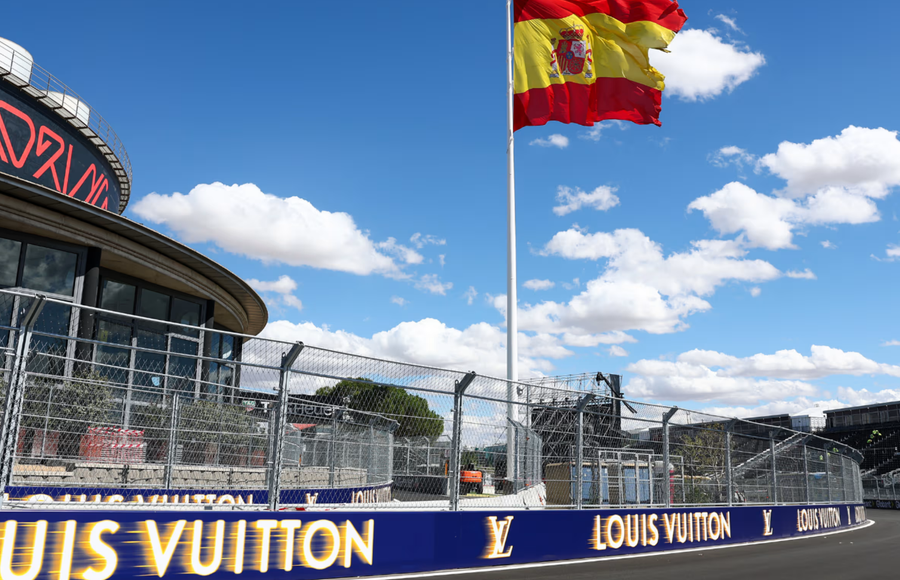
The new Madring circuit, which hosts this weekend’s Spanish Grand Prix, is Formula 1’s first new circuit since Las Vegas in 2023.
It is officially a street circuit because it runs around the IFEMA Exhibition Centre near Madrid’s main airport. But around half of the track feels more like a normal race circuit as it heads towards the famous La Monumental banked turn.
Madring circuit also has some big changes in height. From Turn 7 to Turn 8, the track climbs by 8% on its own. It looks even better in person than it probably does in photos.
The drivers still have another 24 hours before they get out on track, but the first look at Madring circuit has already given us an idea of what could make this a tough weekend for F1.
1. La Monumental is impressive
The corner everyone has been talking about at Madring is, of course, the banked section at La Monumental.
It has stood out ever since the first designs of the track were shown. Drivers, teams and Pirelli have all said it could be one of the hardest corners of the season.
It already looked impressive while it was being built. Now that the work around the 550-metre-long turn is finished, it looks even better.
The grandstands sit high above the corner, while a huge hospitality area has been built on the inside. Together, they give the place the feel of a huge stadium. It also has some of the same atmosphere as the start-finish straight at Interlagos.
The big question now is whether drivers will be able to use different lines through the corner. If they can, it could make the racing even more interesting.
2. Turn 5 may be where drivers run into trouble
There are several parts of Madring that could cause problems for drivers.
La Monumental is one of them. Turn 17 could be another, with drivers needing to brake hard for the right-hander after coming through a fast left-hand section. That could be a tricky part of the lap.
But what we saw during F3 testing suggests the Turn 5/6 chicane could be the biggest problem.
It comes after the fastest part of the track, the long sweeping section from Turn 3. Drivers then have to deal with a tricky chicane.
The kerbs will need to be used carefully. But the barrier on the exit could be an even bigger problem. It gets very close to the track and could catch drivers out.
3. The circuit surface is extremely smooth
Street circuits have often been known for their bumps, but Madring is very smooth.
A walk around the track shows that the new surface should not cause many problems for the cars. Drivers should not have to worry about unexpected bumps forcing them to change how high the cars sit off the ground.
The walls mark the edge of the track in many places, which makes it clear where drivers cannot go. In some other areas, painted kerbs have been added to keep the cars away from the concrete.
The FIA has also added small painted lines to help drivers stay inside the white lines. Similar lines are already used at tracks such as Jeddah, Miami and Austin.
4. The paddock is much bigger than expected
One of the first challenges for everyone arriving at Madring circuit has been simply finding their way around the F1 paddock. It is absolutely huge.
The team garages have been placed inside the IFEMA exhibition centre, which has created a very different setup from a normal F1 paddock.
Instead of having all the garages in one long row, there is a 150-metre gap between Williams and Racing Bulls. The media and TV pen has been placed in that space.
There is also a different setup behind the garages, where the team trucks and engineering offices are located. The hospitality areas are in a separate section.
Because of the way the IFEMA complex is built, some teams are inside air-conditioned buildings. Others, including McLaren and Mercedes, are outside in the heat.
There are also some surprisingly large gaps between teams. Walking from Williams to Racing Bulls, who are normally next to each other in the paddock, takes more than two minutes.
Also Read: The Best Formula 1 Drivers Ever Ranked by Wins and Championships
5. The long pitlane has a tricky exit
The unusual garage layout has also made the pitlane very long. Very, very long.
The official distance between the two speed limiter lines is 562 metres.
There is also a lot of extra distance on the way out. That could make the exit tricky, as cars will accelerate towards a right-hand concrete barrier before joining the track again at Turn 3.
Pirelli estimates that drivers will lose around 25 seconds when making a pit stop. The loss is helped a little because the pit lane does not come back onto the track at the first corner. Instead, it rejoins at Turn 3.